
There are no historical analogies that adequately encompass this moment. Observers are pointing to 1974, the post-Watergate midterm, when Democrats swept into power. And yes, the margin is similar, with Democrats winning +13 in the popular vote this year. But the polarization of our politics, particularly in the Trump era, makes this unprecedented.
This was a wholesale repudiation of Donald Trump. It was a repudiation of his policies—63 percent of exit poll respondents said higher than usual prices are a result of Trump’s policies, 66 percent said Trump’s tariffs have hurt the economy, 65 percent said taking military action in Iran was the wrong decision and 89 percent said cost of living was a crucial or major factor in their vote. Additionally, 62 percent said he prioritizes his personal interests over the country’s interests and 90 percent said corruption was a crucial or major factor in their vote. While JD Vance blamed the war in Iran, voters blamed Trump and Republicans writ large.
It was also a repudiation of his politics. The Trump-mandated redistricting efforts backfired, with Republicans projected to flip only 1-4 redistricted seats while Democrats have flipped 5. Candidates hand-selected by Trump from Mississippi to North Carolina to Ohio to Texas lost badly. Perhaps most notably, candidates who engaged in Trump-like tactics including Attorney General Ken Paxton, former Rep. Mike Rogers and Vivek Ramaswamy, also lost badly. Trump’s 2024 coalition collapsed and voters who swung toward Republicans in 2024, notably young men and Hispanics, swung back—hard. Voters (finally) rejected Trump and MAGA.
Toplines: Democratic Wins
The results were so overwhelming that Republicans conceded on election night, like normal politicians. Even President Trump didn’t deny the results. We didn’t just win in red states and districts; we won by crazy margins. The margin of error in polling was real—it was just in our favor this time. This was a larger polling miss than the error that overestimated Republicans in 2016 and 2024. As in the 2025 gubernatorial elections, polls underestimated Democratic performance, likely being too reliant on past Trump voters sticking with the GOP.
With Democrats likely to win 56 Senate seats (we are confident in both Alaska and Mississippi), it is now virtually impossible for Democrats to lose the Senate before 2033. This makes a federal trifecta in 2029 a real possibility. Democrats in the Senate now have the ability to block extreme judicial nominations and grossly unqualified Cabinet appointments. Democrats will hold at least 255 seats in the House, with more than 20 still too close to call. We can afford to lose several members on votes and no wing of the party can hold the agenda hostage. We can pass meaningful legislation and force Trump’s hand to veto. And with congressional subpoena power, we can conduct actual oversight of this corrupt Administration.
On the gubernatorial front, if the remaining results go as expected (including Alaska and Kansas), Democrats will hold 30 governorships in states totaling 392 electoral votes and 75 percent of Americans will live in a state with a Democratic governor.
Democrats won trifectas in Arizona, Michigan, Minnesota, Nevada, Pennsylvania, and Wisconsin; 53 percent of Americans will live under a Democratic trifecta. Not only will this mean actual governing power and the ability to do big things, but we have the opportunity to pass the National Popular Vote compact in enough states to make the electoral college irrelevant.
Democrats will now control a majority of state legislative chambers, and we picked up at least 500 state legislative seats, gained six Democratic supermajorities, broke 10 Republican supermajorities and flipped 12 chambers. This bodes well for 2028 but also the critical 2030 elections, which will determine post-census redistricting.
Toplines: Women Powered the Wave


When all races are called, we expect at least 117 Democratic women will serve in the US House, comprising approximately 46 percent of the caucus. Women overall will hit a new record—137. The previous record was 127, set at the end of the 118th Congress (2023-25). That will put women at an all-time high of 32 percent of Congress. While the overall number of women in the Senate will decrease from 27 to 25, the number of Democratic women will increase from 16 to 18 (including Mary Peltola).
Women now make up 15 of the 30 Democratic governors, reaching gender parity. We elected our country’s first Black woman governor and first Native woman governor. With 15 female executives, ranging from Oregon to Texas to Maine, we hope the exhausting narrative questioning whether a woman can be elected president can be put to rest. Notably, once states get a taste of women in power, they like it; Kansas, Maine, Michigan and New Mexico all replaced women governors with new women and Minnesota, New Hampshire, Oregon and Tennessee all featured women vs. women general elections.
In another critical statewide office—attorney general—we’ll see five new women take office. Rhode Island elected its first female attorney general, and Georgia elected its first Black woman attorney general.
While the full demographic picture of overall gains at the state legislative level are still coming into focus, with many races yet to be called, two things are already clear: Democrats have wiped out the 2020 red wave victories that gerrymandered many states for a decade or more; and women candidates played a critical role in victories.
Across the 16 states where our local groups hosted state legislative events and provided candidate support through national programming, our women are winning. So far, our tracking shows only one loss, at least 22 legislative seat flips and 14 additional gains for women—and counting. In states with new trifectas, three had women running at the top of the ticket: Minnesota (Amy Klobuchar), Arizona (Katie Hobbs), Michigan (Jocelyn Benson), Pennsylvania and Wisconsin.
Much more to come as elections are called and certified.
The Electing Women Way
So, in an election that cost $12 billion, how did our money make a difference?
- We raise hard side money, direct to the candidate.
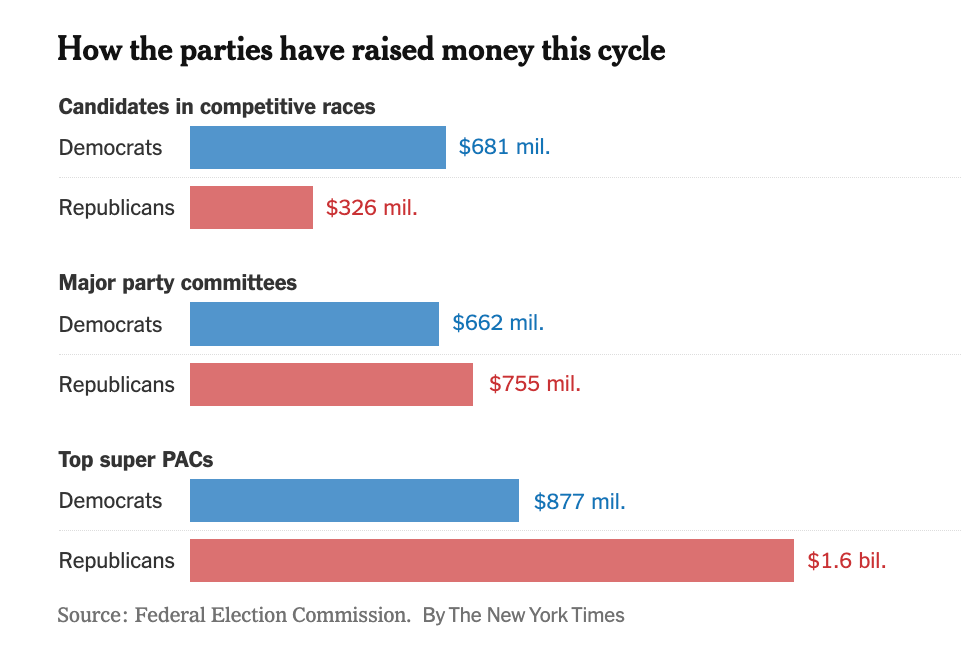
This election cycle solidified the importance of hard-side money, that is, money donated directly to a candidate. In the wake of Citizens United and the rise of soft-side funding (SuperPACs and 501c4 dark money), hard-side money truly won the day for Democrats. Most Democratic candidates, especially for US Senate, were dramatically outspent on the soft side but made up funding differences with more efficient hard-side dollars. What does this mean? On average, candidates pay $191 vs. $417 for SuperPACs, or 2.2X more (as of 10/9) for a media point. In some places, like Texas, SuperPACs paid 9X more than candidates!
Three governor’s races prove our theory that women don’t have to spend dollar for dollar, they just need enough to be competitive and get their message out. In Georgia, former Atlanta Mayor Keisha Lance Bottoms won the competitive five-way Democratic primary and started the general election with little in the bank. She faced a self-funder, Rick Jackson, who spent $80 million of his own money to unexpectedly win the Republican primary. Jackson went on to spend an additional $120 million to Lance Bottoms’ $30 million. Our network mobilized for her immediately after the primary, raising over $330,000 and demonstrating our belief that we could elect the country’s first Black woman governor.
A similar story played out in Ohio. Republican Vivek Ramaswamy put in $41 million of his own money, half of his $82 million in spending, to Democrat Dr. Amy Acton’s $37 million. But his despicable ad featuring Amy Acton’s estranged mother was the nail in the coffin for his campaign. Acton was already favored to win but his spectacular miss certainly helped. EWA raised more than $481,000 for her campaign and her candidacy helped us launch a new group in Cincinnati.
In Texas, incumbent Gov. Greg Abbott had amassed an astonishing $105 million war chest by 2025, intimidating most viable Democrats from running. But state Rep. Gina Hinojosa believed her people-powered campaign, focused on education and data centers, could overcome Abbott’s cash advantage—and she was right. Abbott outspent Hinojosa by an astonishing 8:1 margin, $281 million to Hinojosa’s $36.8 million, with a big assist from Elon Musk. EWA raised more than $176,000 for Hinojosa, anchored by our Austin group who championed her candidacy from the beginning.
The female candidates in competitive races—former Rep. Mary Peltola (AK), Lt. Gov. Peggy Flanagan (MN) and Dr. Annie Andrews (SC)—raised on average $21 million for the cycle versus $45 million for Democratic men in competitive races. This Democratic disparity has also remained steady between quarters. These women raised an average of $4.2 million in Q2 and $10.2 million in Q3 while men raised on average $9.6 million in Q2 and $24 million in Q3. The chart below demonstrates the incredible disparities.

Source: The New Republic from FEC data
We also saw a massive hard-side fundraising disparity in the Illinois Senate primary, where Rep. Raja Krishnamoorthi spent $27 million, Lt. Gov. Julianna Stratton spent $5.4 million, and Rep. Robin Kelly spent $3.3 million. Stratton was helped by an outside independent expenditure but, once again, a woman was dramatically outspent yet had enough hard side money to win. EWA supported Stratton early and stepped in especially toward the end of the primary, when she suddenly surged but needed hard-side dollars specifically.
- We host early and often
We are there at the beginning and we will host candidates early and often, multiple times in a cycle for the most competitive races. Our network—the secret sisterhood, as Sen. Angela Alsobrooks dubbed us—is there as a supportive and welcoming force, often as a candidate’s first out-of-state fundraising event. Multiple candidates have talked about our events as a hug, making the intimidating world of fundraising a little easier on the road.
We started off the cycle supporting women gubernatorial incumbents early. We knew Gov. Katie Hobbs would have a tough and expensive re-election in the swing state of Arizona; our network raised more than $516,000 for her campaign, the most for any gubernatorial candidate, and many groups hosted her multiple times throughout the cycle.
We also helped Govs. Kathy Hochul (NY) and Tina Kotek (OR) amass funds while Republican primaries played out. We hosted multiple women during both their primary and general election campaigns, raising more than $410,000 for Secretary of State Jocelyn Benson in Michigan and more than $329,000 for former Interior Secretary Deb Haaland in New Mexico, bolstered by our new Michigan group and longtime New Mexico group. We helped Sen. Amy Klobuchar quickly raise funds when she stepped into the governor’s race, raising more than $340,000 for her campaign, and the Klobuchar-Flanagan ticket spurred a new Twin Cities EWA group. Later in the cycle, we supported Helena Buonanno Foulkes in her successful effort to defeat a sitting governor in the Democratic primary in Rhode Island and hosted a Zoom featuring state Sen. Cyndi Holscher (KS, now Gov-elect) and Lynne Walz (NE).
We also support candidates in primaries, which is increasingly rare in the funder world. When there are multiple viable women in a primary, we encourage groups to host all women. Our goal is to ensure women are funded and competitive.
On the Senate side, Illinois, Michigan and Minnesota all saw open seats with multiple women candidates, complicating our efforts. But our network stepped up and hosted throughout the primary process, ultimately helping propel Stratton (IL) and Flanagan (MN) to victory. Peltola cleared the field in Alaska and the Electing Women network raised more than $784,000 for her campaign, the most for any Senate candidate this cycle. We also supported Andrews (SC), raising more than $132,000, and we raised for state Rep. Angie Nixon (FL), hosting a national Zoom with Sens. Alsobrooks and Lisa Blunt Rochester.
- Focusing on candidate quality
We know the difference women make as candidates. While we do not play a major role in recruitment, we work closely with numerous partners from the Democratic Governors Association to The States Project. We also see these women in intimate, off-the-record settings and have a unique vantage point on their candidacy. We know women are the most trusted messengers on affordability and Democrats need a multi-cycle strategy focused on centering women candidates and kitchen table issues. We also saw the power of the Epstein cover-up, with candidates across the country spending more than $40 million on Epstein-related ads; women will not forget Trump’s centrality to this scandal and the Republicans who enabled it.
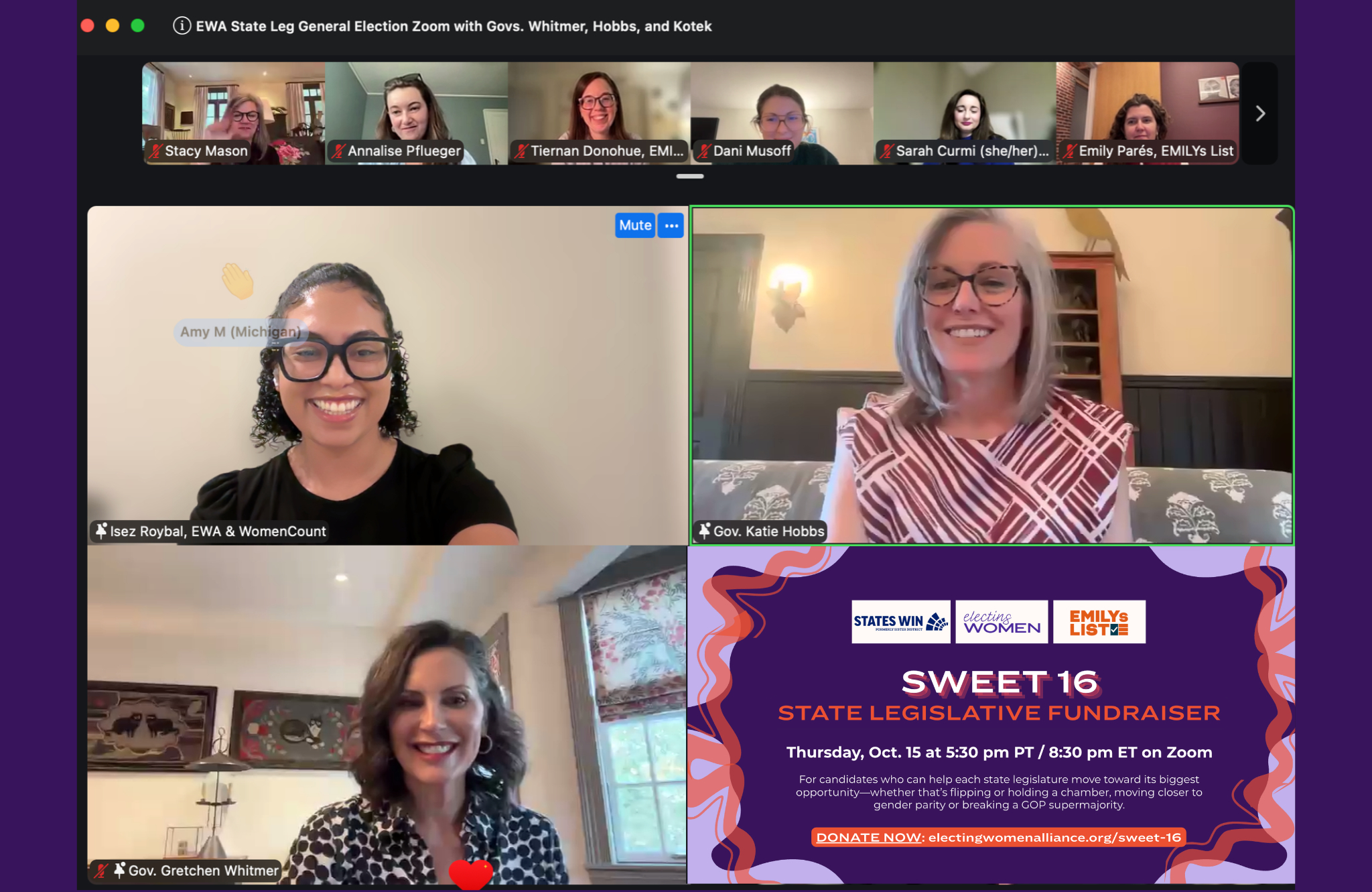
To support women running down-ballot, we hosted a series of national Zooms. We featured women who needed support to win their primary in the spring, competitive attorneys general races over the summer, and the “Sweet 16” candidates in the fall—women running for state legislative seats in states with women gubernatorial candidates. Our partners on these events included CAREGivers, EMILYs List, States Win, The First Ask, MI List, Arizona List, LEAD Ohio, Women in Clean Energy, Vote Mama, and LGBTQ+ Victory Fund. Groups including Austin, the Bay Area, Chicago, Dallas, Denver, Michigan, North Carolina, Seattle, St. Louis, Tennessee and Wisconsin also hosted in-person local events for downballot candidates, including candidates running for state legislature, state supreme court, secretary of state and attorney general.
In total, we raised more than $602,000 for downballot candidates.
What’s Next
The work doesn’t stop. In 2027, Kentucky, Louisiana and Mississippi will host gubernatorial and state legislative elections, and New Jersey and Virginia will also hold state legislative elections. We are ready to support Lt. Gov. Jacqueline Coleman in her bid for governor in Kentucky and we must continue the historic gains made in the South this year by supporting more women running up and down the ballot.
The 2028 Senate elections feature several female incumbents including Sens. Tammy Duckworth (IL), Catherine Cortez Masto (NV), Maggie Hassan (NH) and Patty Murray (WA). We will likely see some retirements leading to open seats with women candidates (potentially in New York and Vermont). And there are several opportunities to flip purple seats including Florida (we’re hoping Nixon mounts a rematch), Iowa, North Carolina and Wisconsin.
All of those Democrats who flipped Trump seats in 2026 are now Frontline Democrats who will need funding to withstand the more competitive presidential-level turnout.
And, of course, the presidential election has already started. With as many as 25 Democrats potentially tossing their hats in the ring, it is on us to make sure the women candidates are funded early, get on the debate stage, and have the opportunity to make their case to the American people.
No rest for the weary. Or the women.